

Media coverage is useful, but coverage alone rarely answers the CEO’s real question: did PR change anything that matters to the business?
A long list of media mentions may show that a campaign was active. It does not always show whether the brand became more trusted, more visible than competitors, or more clearly associated with the right message. That is why executive PR reporting needs to move beyond clippings, impressions, and reach.
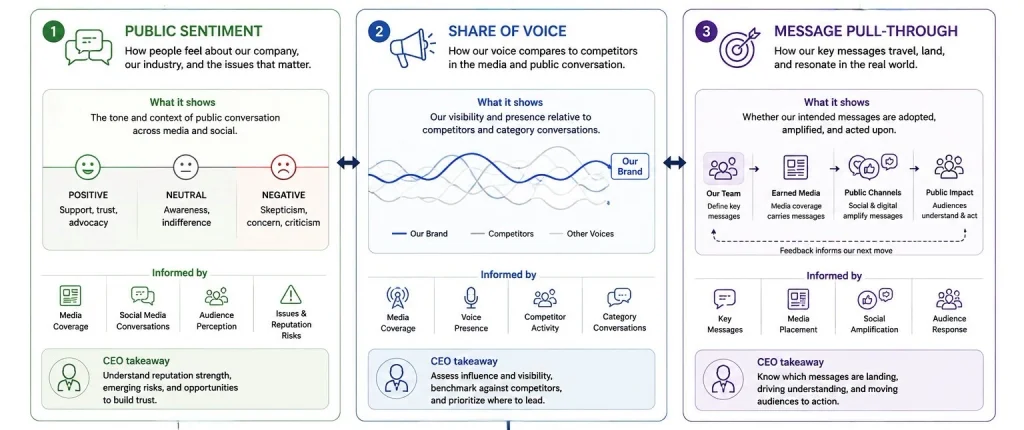
The PR metrics CEOs care about most are usually the ones that connect communication activity to reputation, competitive position, and decision-making. Three of the most useful are:
- Sentiment
- Share of voice
- Message pull-through
Metric 1: Sentiment — Are People Reacting Positively, Negatively, or Neutrally?
Sentiment analysis measures the tone of media coverage, social conversations, reviews, comments, and other brand mentions. In PR reporting, sentiment is usually grouped as positive, negative, or neutral, but the real value comes from understanding why the sentiment changed.
Sentiment is one of the most important PR metrics for CEOs because it shows whether media visibility is improving or damaging brand perception.
For example, a campaign may generate hundreds of mentions, but if most of the discussion is negative, high visibility may not be a success. On the other hand, a smaller number of high-quality mentions with positive sentiment in trusted publications may be more valuable than a large volume of neutral coverage.
A useful sentiment report should not stop at percentages. It should explain the reason behind the trend and recommend the next communication action.
Metric 2: Share of Voice — Are We Leading the Conversation or Losing It?
Share of voice in PR reporting measures how much of the relevant media conversation your brand owns compared with competitors. It can be measured across a market, topic, channel, campaign, country, or time period.
Share of voice matters to CEOs because it shows whether the brand is gaining or losing competitive visibility in the conversations that influence market perception.
For example, a company may want to know whether it is leading the conversation around innovation, sustainability, customer trust, national contribution, financial performance, or executive leadership. A share of voice report can compare the brand against key competitors and show who is more visible in each topic.
However, share of voice should not be treated as a simple volume contest. More mentions do not always mean stronger PR performance.
A better share of voice analysis considers:
- Source quality
- Message relevance
- Sentiment
- Prominence of the brand mention
- Market or country
- Competitor set
- Topic category
- Media type, such as online news, print, broadcast, or social media
A strong PR report might say: “Our brand led competitor share of voice in customer trust and service reliability, while Competitor A gained more visibility in sustainability coverage.”
That kind of insight is more useful than saying: “We received 240 mentions this month.”
Metric 3: Message Pull-Through — Are Our Strategic Messages Actually Landing?
Message pull-through measures whether the company’s intended messages are appearing in earned media coverage and public conversations.
If a company wants to be known for innovation, customer trust, sustainability, national contribution, industry leadership, safety, or digital transformation, then PR teams need to measure whether those messages are actually being repeated in the media.
Message pull-through is a CEO-level PR metric because it shows whether communication is shaping the intended narrative, not just generating attention.
To measure message pull-through, PR teams can create a message bank and tag coverage against each priority message. Each mention can be scored as:
- Full message pull-through
- Partial message pull-through
- Brand mention only
- Off-message coverage
- Negative or conflicting narrative
This makes PR reporting more useful for leadership because it shows whether the brand’s narrative is reaching the market.
Message pull-through, sentiment, and share of voice are often used together in PR reporting dashboards because they help teams focus on quality, not only volume.
Common Mistakes PR Teams Should Avoid
PR teams can make executive reporting stronger by avoiding these common mistakes:
- Reporting coverage volume without explaining quality
- Treating all media mentions as equal
- Measuring sentiment without explaining what caused the change
- Comparing share of voice without defining the competitor set
- Tracking messages that are too broad or vague
- Sending leadership data without recommendations
- Ignoring regional, language, or cultural context
- Reporting only after an issue grows instead of monitoring in real time
The goal is not to produce longer reports. The goal is to produce clearer reports.
How 24ieye Supports PR Measurement and Executive Reporting
For brands operating across Oman, the GCC, and wider global markets, PR reporting often requires more than basic media tracking. Leaders need to understand how their organization is being discussed across digital media, print, broadcast, social platforms, and competitor conversations.
24ieye’s PR Insights, Media Intelligence, Social Media Listening, Reputation Management, and Digital Risk Monitoring solutions are designed to help organizations track brand mentions, analyze sentiment, compare competitor visibility, identify potential reputation risks, and organize insights into clearer reporting.
Final Takeaway
Sentiment shows whether visibility is helping or hurting the brand. Share of voice shows whether the brand is gaining attention against competitors. Message pull-through shows whether the intended narrative is reaching the market.
Together, these metrics turn PR reporting into a strategic intelligence function. They help communications teams explain reputation, competition, narrative control, and business risk in language leadership can act on.
Frequently Asked Questions
What PR metrics do CEOs care about most?
The PR metrics CEOs usually care about most are sentiment, share of voice, message pull-through, media quality, reputation risk, competitor visibility, and campaign impact.
How do you prove PR value to executives?
PR teams can prove value by connecting media coverage to business-relevant outcomes such as reputation, audience perception, competitive visibility, message adoption, and risk awareness.
What is share of voice in PR reporting?
Share of voice measures how much of the relevant media conversation a brand owns compared with competitors across selected topics, channels, markets, or time periods.
What is message pull-through in PR?
Message pull-through measures whether a company’s intended strategic messages are appearing in media coverage, interviews, social conversations, and campaign discussions.
What should be included in an executive PR dashboard?
An executive PR dashboard should include sentiment trends, share of voice, message pull-through, media quality, risk alerts, competitor comparison, and recommended actions.